

Artificial intelligence is changing how businesses manage legal compliance and regulatory monitoring. Instead of relying only on manual tracking, AI tools can scan updates, review policies, detect risks, and organize compliance data in real time. This helps legal teams respond faster, reduce missed obligations, and manage regulatory changes with greater consistency.
What AI Means for Legal Compliance
 Legal compliance involves following laws, rules, standards, and internal policies that apply to a business or organization. These obligations may involve privacy, employment, finance, contracts, cybersecurity, healthcare, consumer protection, and many other areas.
AI in legal compliance refers to software that helps monitor these obligations, identify possible risks, and organize legal data. These tools can review documents, track deadlines, compare policies, and alert teams when regulations change.
AI does not remove the need for human judgment. Legal professionals still need to interpret rules, apply context, and decide what actions are appropriate. However, AI can reduce repetitive work and make compliance systems easier to manage.
Why Regulatory Monitoring Is More Difficult Today
Regulations are constantly changing. Businesses may need to follow federal, state, local, and international rules. A company that operates online may also need to comply with privacy laws, advertising rules, cybersecurity standards, and industry-specific requirements.
Manual monitoring can be difficult because legal teams must review many sources. They may need to check government websites, agency updates, court decisions, policy changes, and industry guidance. When teams rely only on manual review, important updates can be missed.
AI tools can help by scanning large amounts of information and organizing updates by topic, urgency, and business relevance.
How AI Tracks Regulatory Changes
AI-powered compliance platforms can monitor regulatory sources and flag updates that may affect a business. These tools may track new rules, amendments, enforcement actions, reporting deadlines, and proposed regulations.
For example, a business that handles customer data may need to track privacy rules from multiple jurisdictions. AI can help identify updates related to data collection, consent, security, and breach notification.
For general business guidance on privacy and security, readers can review the Federal Trade Commission privacy and security resources.
AI and Compliance Risk Detection
One of the strongest uses of AI in compliance is risk detection. AI systems can analyze policies, contracts, reports, and internal documents to find possible compliance gaps.
For example, an AI tool may flag a missing privacy policy, an outdated employee handbook, or a vendor agreement without proper data protection language. It can also identify repeated issues across departments.
This helps legal and compliance teams prioritize their work. High-risk issues can be reviewed first, while lower-risk items can be handled through standard procedures.
Using AI to Review Internal Policies
Internal policies help businesses explain expectations to employees, vendors, and managers. These policies may cover workplace conduct, data privacy, cybersecurity, financial controls, harassment prevention, records retention, and reporting procedures.
AI can compare internal policies against current legal requirements or company standards. It can highlight outdated language, missing sections, or inconsistent terms.
This is useful for companies with many departments or locations. Instead of reviewing every policy manually, compliance teams can use AI to identify where updates may be needed.
AI in Data Privacy Compliance
Data privacy is one of the most important areas for AI-supported compliance. Businesses collect, store, and share large amounts of personal information. Privacy laws may require clear notices, consent procedures, data access rights, and security protections.
AI tools can help identify where personal data appears in documents, systems, and contracts. They can also support data mapping, vendor review, and breach response planning.
Businesses that handle personal information may also review guidance from agencies such as the U.S. Department of Health and Human Services HIPAA resources when health information is involved.
AI and Contract Compliance
 Contracts often contain compliance obligations. These may include audit rights, reporting duties, payment deadlines, confidentiality rules, insurance requirements, and data protection terms.
AI can review contracts and extract these obligations into a structured format. This helps teams track what must be done, who is responsible, and when deadlines occur.
For related reading, you can link to your existing post about AI court translation and human judgment in courts. This connects the topic of AI support with the continued need for professional oversight.
How AI Supports Compliance Audits
Compliance audits require careful review of records, policies, procedures, and evidence. AI can help organize this process by finding documents, checking for missing information, and summarizing key findings.
For example, an AI tool may scan employee training records and identify who has not completed a required course. It may also review vendor files and flag missing certificates, agreements, or security documents.
This can make audits more efficient. It can also help businesses prepare before an outside regulator, client, or auditor requests information.
AI Dashboards and Real-Time Monitoring
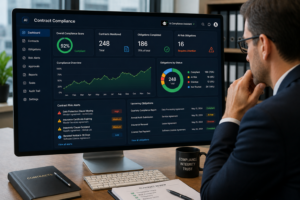
Many compliance tools use dashboards to display risk levels, alerts, deadlines, and open tasks. AI can improve these dashboards by turning raw information into useful insights.
A dashboard may show which regulations are being monitored, which departments have pending tasks, and which risks require immediate review. It can also rank alerts based on urgency.
This helps compliance teams avoid scattered information. Instead of searching through emails, spreadsheets, and folders, teams can use one central system to track obligations.
Benefits of AI in Legal Compliance
AI can improve legal compliance in several practical ways. It can reduce manual research, speed up document review, improve consistency, and help teams identify risks earlier.
AI can also support better reporting. Compliance leaders often need to explain risks to executives, boards, or outside auditors. AI tools can organize data into summaries, charts, and task lists.
Another benefit is scalability. As a business grows, compliance obligations often increase. AI can help teams handle more information without relying only on manual processes.
Challenges of Using AI for Compliance
AI tools are useful, but they are not perfect. A system may misread a regulation, miss context, or flag issues that are not actually problems. Legal teams should review AI output carefully.
Another challenge is data quality. AI tools need accurate, current, and relevant information. If the source data is outdated or incomplete, the results may be unreliable.
Security is also important. Compliance documents may include sensitive business information, employee data, client records, or legal strategy. Businesses should understand how AI vendors protect uploaded data.
Ethical Considerations in AI Compliance Tools
Legal and compliance teams should consider transparency, accountability, privacy, and bias when using AI tools. Users should understand how the system reaches conclusions and whether results can be verified.
AI should not become a hidden decision-maker. It should assist professionals who remain responsible for final decisions.
The National Institute of Standards and Technology AI resources provide helpful information about AI risk management and trustworthy AI practices.
Why Human Oversight Remains Essential
Compliance decisions often depend on context. A regulation may apply differently depending on the industry, location, type of data, or business activity. AI can identify possible issues, but human professionals must decide what the rules mean.
Legal professionals also understand business goals, practical risks, and enforcement trends. These factors cannot be fully captured by automated tools.
The best use of AI is a balanced approach. AI handles monitoring, sorting, and alerts. People handle judgment, interpretation, and final action.
How Businesses Can Use AI Responsibly
Businesses can use AI more responsibly by creating clear policies. Teams should define who can use AI tools, what information can be uploaded, and how results should be reviewed.
Organizations should also train employees on AI limits. A compliance alert should not be treated as final legal advice. It should be reviewed by qualified professionals.
Regular testing also matters. Businesses should check whether AI tools are accurate, secure, and aligned with current legal needs.
The Future of AI in Regulatory Monitoring
AI may become more important as regulations grow more complex. Future systems may provide more accurate alerts, stronger document review, and better connections between legal, compliance, and business teams.
AI may also help companies predict compliance risks before problems develop. For example, a tool may identify repeated policy violations, delayed training, or contract gaps that suggest a larger issue.
As these tools improve, legal teams may spend less time searching for information and more time solving compliance problems.
Conclusion
AI is changing legal compliance and regulatory monitoring by helping businesses track rules, detect risks, review policies, and organize compliance data. These tools can improve speed, consistency, and visibility across legal operations.
However, AI should support human judgment rather than replace it. Regulations require careful interpretation, and compliance decisions often involve context that software cannot fully understand.
When used responsibly, AI can become a valuable tool for legal teams, compliance officers, and business leaders. It can help organizations stay more informed, respond to changes faster, and manage legal obligations with greater confidence.