
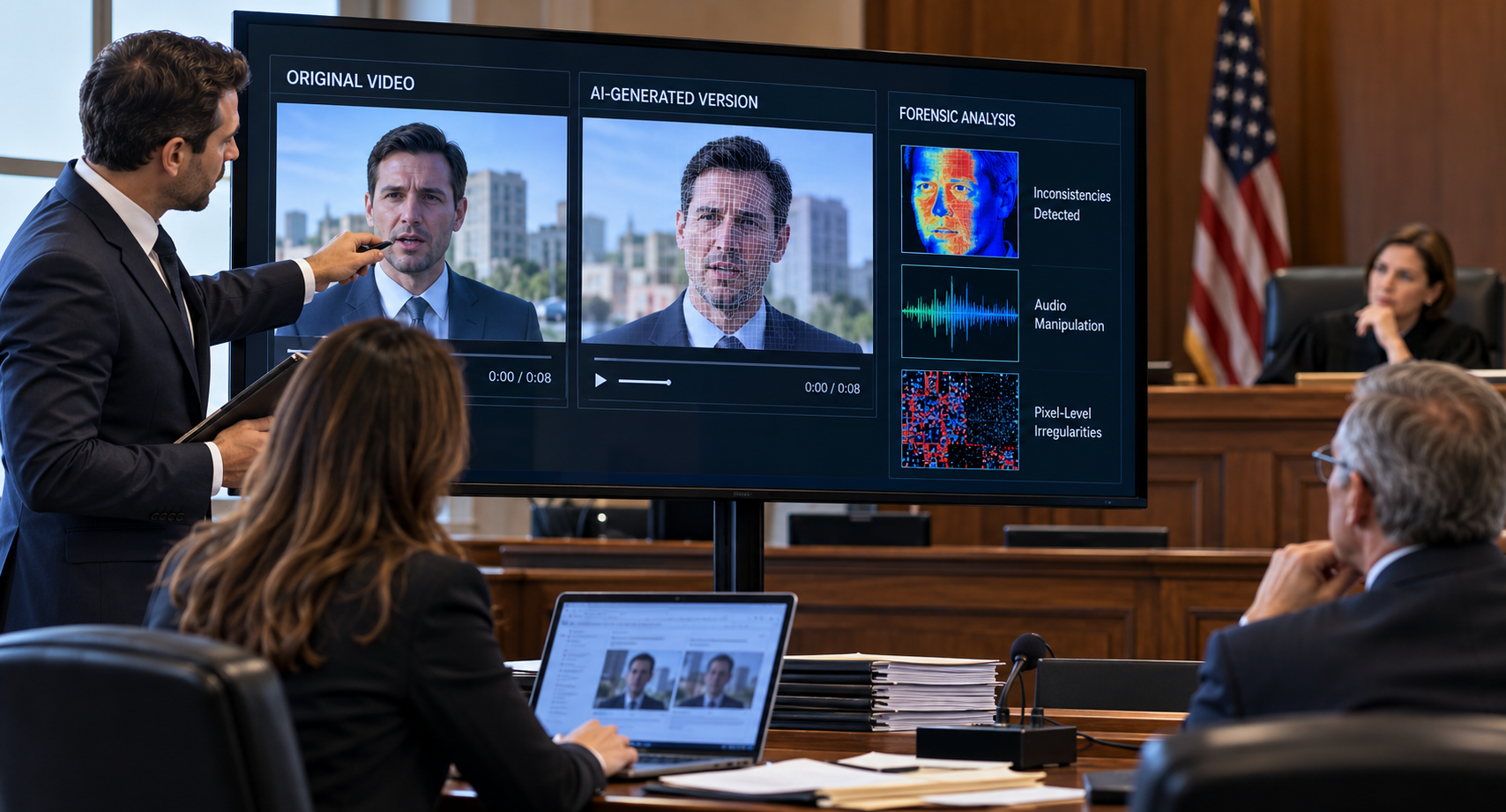
Artificial intelligence is changing one of the most fundamental questions in litigation: Can a court trust what it sees and hears? Photographs, videos, audio recordings, screenshots, and other digital materials have become common forms of evidence. However, generative AI can now create or manipulate realistic images, voices, and videos that may appear authentic even when they do not accurately represent what happened.
This development creates a growing challenge for courts, lawyers, and litigants. Digital evidence must generally be authenticated before it can be relied upon, but determining authenticity becomes more complicated when sophisticated AI tools can fabricate convincing material. The issue is not simply whether a particular photograph or recording is real. Courts may also need to consider how the evidence was created, whether it was altered, who handled it, and what information supports its authenticity.
The Federal Rules of Evidence provide the framework governing evidence in federal proceedings, but the increasing availability of generative AI is prompting courts and rulemakers to consider whether existing authentication procedures are sufficient for emerging forms of digital manipulation.
What Is AI-Generated Evidence?
AI-generated evidence is digital material created or modified with artificial intelligence. It can include synthetic photographs, manipulated videos, cloned voices, altered recordings, generated documents, or other forms of digital content.
Not every use of AI makes evidence unreliable. AI can be used for legitimate purposes such as improving image clarity, transcribing audio, organizing information, or creating demonstrative exhibits. The legal concern becomes more significant when AI-generated or AI-altered material is presented as though it were an authentic representation of an event.
Deepfakes represent one of the most recognizable examples. A deepfake can make it appear that a person said something they never said or performed an action that never occurred. Because modern generative AI can produce highly convincing results, courts may need information beyond simply looking at the final image or recording.
Why Authenticity Matters More Than Ever
 Courts have always dealt with fabricated evidence. Documents can be forged, photographs can be altered, and witnesses can provide inaccurate testimony. What makes AI-generated material different is the speed, accessibility, and sophistication of modern digital manipulation.
A fabricated video can potentially be created without the technical resources that were once necessary for sophisticated editing. A synthetic voice can imitate a person convincingly. A generated photograph can depict an event that never happened.
This creates a problem of trust. If lawyers, judges, or jurors cannot confidently determine whether digital material accurately represents reality, the evidentiary process becomes more difficult.
The National Center for State Courts’ guidance on AI-generated evidence explains that courts may need to examine the source, creation process, chain of custody, metadata, and other information when assessing digital evidence.
Deepfakes and the Problem of Digital Trust
One of the most significant risks associated with deepfakes is that they can affect how people perceive evidence even before a court determines whether the material is authentic.
Video and audio can be particularly persuasive. A recording that appears to show a person making a statement may influence a viewer emotionally, even if the recording is later determined to be manipulated. This makes the timing and manner of authentication especially important.
The problem can work in both directions. A false recording may be presented as authentic, but genuine evidence could also be incorrectly dismissed as a deepfake. A party should not be able to avoid reliable evidence simply by making an unsupported claim that artificial intelligence was involved.
The American Bar Association’s discussion of deepfakes in court highlights both sides of this problem: fabricated evidence can become harder to detect, while legitimate evidence may also face new skepticism.
How Courts Authenticate Digital Evidence
Authentication generally involves establishing that evidence is what its proponent claims it to be. For traditional evidence, this may involve testimony from someone who observed the event, a witness familiar with the document, or other circumstances supporting authenticity.
Digital evidence can require additional information. A lawyer presenting a video may need to explain where it came from, how it was stored, whether it was edited, and who maintained possession of the original file.
Metadata can sometimes provide useful information about a digital file. Other evidence may also help establish authenticity. For example, a recording could be supported by witness testimony, security records, timestamps, related communications, or other independent evidence.
These supporting sources become particularly important when a party challenges digital evidence as potentially AI-generated.
What Happens When Evidence Is Challenged as a Deepfake?
A deepfake allegation should not automatically determine whether evidence is admitted or excluded. Courts may need to evaluate the basis for the challenge and determine whether additional authentication is appropriate.
The federal Advisory Committee on Evidence Rules is currently studying potential changes involving deepfake authentication. A proposed approach under discussion would establish a procedure under which a sufficiently supported challenge could require the proponent of the evidence to demonstrate that the material is more likely than not authentic.
Importantly, this proposal is still being considered and should not be described as an existing federal evidence rule. The October 2026 Advisory Committee agenda materials show that the committee is continuing to examine possible amendments concerning deepfakes and authentication.
Questions Lawyers May Need to Ask
When digital evidence becomes important to a case, lawyers may need to investigate the evidence before presenting it. Important questions can include where the file originated, who created or captured it, whether the original file still exists, and whether anyone modified it.
Other questions may involve the device used to capture the material, the method of transfer, the storage system, and the chain of custody. Lawyers may also need to determine whether independent evidence supports the same event shown in the digital material.
The National Center for State Courts has specifically identified questions concerning source, custody, alteration, metadata, forensic verification, and expert analysis as potentially relevant when AI-generated evidence is challenged.
This represents a broader shift in digital evidence practice. Instead of simply asking whether a file exists, legal professionals may increasingly need to establish why the file should be trusted.
Why Metadata and Chain of Custody Matter
Metadata can contain information about a digital file, including details about its creation, modification, or handling. Metadata is not automatically conclusive, and it can sometimes be changed or removed, but it may provide useful information when combined with other evidence.
Chain of custody is also important. A reliable record of who possessed evidence and how it was transferred can help demonstrate that the material presented in court is the same material that was originally collected.
These principles are familiar in evidence law, but AI makes careful documentation increasingly important. When digital files can be altered convincingly, preserving original material and documenting its history can become an important part of litigation preparation.
Expert Analysis May Become More Important
Some digital evidence disputes may require technical expertise. A forensic examiner may be able to analyze a file, examine metadata, compare versions, or evaluate signs of manipulation.
Expert testimony can also help explain technical issues that judges and jurors may not understand without assistance. However, forensic tools are not necessarily perfect. AI detection technology can produce errors, and a court may need to consider the limitations of the particular method used.
The NCSC guidance on unacknowledged AI-generated evidence recognizes that expert analysis may sometimes be appropriate when authenticity is disputed.
AI Evidence Is Not Always Fake Evidence
It is important to distinguish AI-generated evidence from evidence that merely passes through an AI-powered system.
For example, a legitimate photograph may be enhanced using software to improve visibility. A recording may be transcribed automatically. A document may be processed using optical character recognition. These uses do not necessarily mean that the underlying evidence is fabricated.
The legal question should therefore focus on what the AI system actually did. Did it simply organize or clarify existing information, or did it generate content that purports to depict something that never occurred?
This distinction can help courts avoid treating every use of artificial intelligence as inherently unreliable.
California and the Growing Focus on Responsible AI
California has already taken steps to address responsible use of generative AI within its court system. California Rule of Court 10.430 addresses generative AI use policies for court staff and judicial officers and includes requirements involving accuracy, confidentiality, bias, and disclosure.
The rule does not establish a general rule that every AI-generated exhibit is inadmissible. Instead, it demonstrates how courts are developing policies around responsible use of generative AI while maintaining human oversight.
California’s approach is significant because it reflects a broader principle: courts can use emerging technology while still requiring people to remain accountable for the accuracy and appropriate use of AI-assisted material.
How AI Could Affect Lawyers and Litigants
Lawyers may increasingly need to investigate the authenticity of photographs, recordings, videos, screenshots, and other digital evidence during case preparation.
This does not mean every piece of evidence requires expensive forensic testing. Instead, legal teams may need to develop practical procedures for identifying higher-risk evidence and determining when additional verification is appropriate.
Litigants may also need to preserve original files rather than relying solely on copies or compressed versions. Maintaining documentation about how evidence was collected and stored can make later authentication easier.
These practices can be particularly important when evidence is central to a disputed factual issue.
How Courts Can Question AI-Generated Evidence
Courts examining disputed digital evidence may consider several basic questions. What is the source of the evidence? How was it created or captured? Who possessed it? Has it been edited or converted? Is there independent information supporting its authenticity?
Courts may also consider whether expert testimony or forensic examination is necessary. The National Center for State Courts has developed guidance specifically addressing these questions and encourages judges to examine the circumstances surrounding AI-generated or allegedly AI-generated evidence.
These questions do not automatically establish whether evidence is genuine. They provide a structured way to evaluate authenticity rather than relying solely on appearance.
The Risk of False Deepfake Claims
The emergence of deepfakes creates another concern: genuine evidence could be challenged without a sufficient factual basis.
If simply calling something a deepfake were enough to undermine evidence, litigants could potentially use the allegation as a litigation tactic. Courts therefore need a balanced approach that protects against fabricated evidence without creating a loophole for rejecting authentic material.
The developing federal discussion recognizes this tension. The Advisory Committee is considering how authentication rules could address legitimate concerns about AI manipulation while preventing unsupported challenges from becoming routine.
Juries and the Problem of Persuasive Digital Evidence
Digital evidence can have a powerful effect on jurors. A realistic video or audio recording may appear more persuasive than written testimony because people can see or hear the supposed event directly.
That makes authenticity particularly important. If jurors are shown fabricated material before its reliability is established, the evidence could potentially influence their perception of the case even if questions arise later.
Courts may therefore need to consider not only whether evidence is technically admissible but also whether additional explanations, limitations, or expert testimony are necessary to help jurors evaluate it appropriately.
The Future of Digital Evidence in Court
 The legal system is entering a period in which proving that digital evidence is authentic may become nearly as important as presenting the evidence itself.
Future litigation may involve stronger preservation practices, expanded forensic analysis, authentication protocols, and clearer procedures for challenging suspected AI manipulation. Courts may also develop additional guidance as judges encounter more disputes involving synthetic media.
The federal judiciary’s continuing examination of deepfakes demonstrates that this issue is still developing. The October 2026 Evidence Rules agenda includes continued discussion of a possible Rule 901(c) addressing deepfake authentication, while the committee is also continuing its consideration of AI-generated material offered as evidence.
Why Human Judgment Still Matters
Technology may become increasingly capable of detecting manipulation, but courts will still need human judgment. Judges must decide how much weight evidence deserves, whether authentication requirements have been satisfied, and how competing evidence should be evaluated.
Lawyers also remain responsible for the evidence they present. Technology can assist with investigation and verification, but professional judgment remains necessary when deciding whether evidence is reliable enough to use.
This reflects a theme that appears throughout modern legal technology. AI can make legal work faster and provide new analytical capabilities, but it does not eliminate the need for human responsibility. The same principle can be seen in discussions about AI court translation and human judgment, where technology can assist legal communication without replacing professional oversight.
Building Trust in an AI-Enabled Courtroom
Trust in digital evidence will increasingly depend on transparency. Lawyers should be prepared to explain where important evidence came from and how it was preserved. Courts may need procedures that allow parties to raise legitimate authenticity concerns without turning every digital exhibit into a technical dispute.
At the same time, the justice system must avoid assuming that technology is automatically unreliable. AI can create false evidence, but it can also provide legitimate tools for organizing, analyzing, and verifying information.
The challenge is therefore not to reject digital evidence. It is to develop reliable methods for distinguishing trustworthy evidence from material that has been manipulated or fabricated.
Conclusion
AI-generated evidence is changing the way courts think about authenticity, reliability, and digital trust. Deepfakes can make fabricated photographs, videos, and audio recordings appear convincing, while unsupported deepfake allegations can create problems of their own.
Courts, lawyers, and litigants will increasingly need to examine the source, chain of custody, metadata, creation process, and supporting evidence surrounding important digital material. In some cases, expert analysis may be necessary.
The legal system is still developing its response. Federal evidence rulemakers are actively studying potential changes concerning deepfakes, while organizations such as the National Center for State Courts are developing practical guidance for judges and legal professionals.
The ultimate goal should not be to make courts suspicious of every digital file. It should be to create a reliable process for determining which evidence can be trusted. As artificial intelligence becomes more capable, authentication and human judgment will remain essential parts of a fair judicial system.
For readers interested in the broader relationship between language, technology, and access to justice, ESQ’s discussion of language barriers and access to justice provides another perspective on how changes in technology and communication can affect the legal system.