
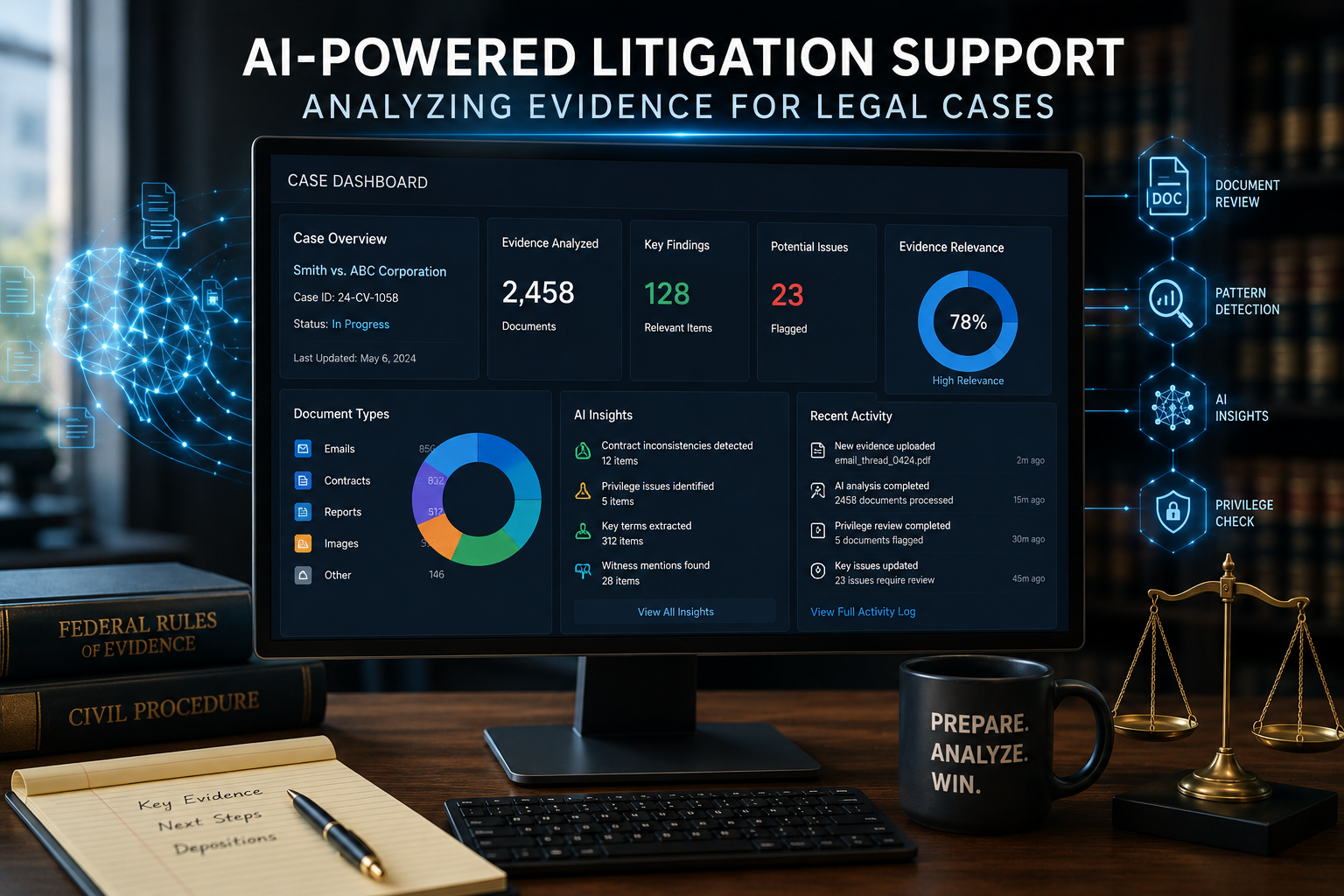
Electronic discovery, or e-discovery, is an essential part of modern litigation. Legal teams must review large volumes of electronic documents, emails, contracts, and other records to identify relevant evidence. Traditionally, this process has been extremely time-consuming and prone to human error. Artificial intelligence (AI) is transforming e-discovery by automating document review, identifying key evidence, and streamlining case preparation for lawyers.
What E-Discovery Means in Litigation
E-discovery refers to the process of collecting, reviewing, and producing electronically stored information (ESI) for litigation. ESI includes emails, chat logs, word documents, PDFs, spreadsheets, and even social media content. Legal teams must ensure they capture all relevant information while maintaining data integrity and confidentiality.
AI in e-discovery enables faster and more accurate processing of this information. Machine learning algorithms can identify relevant documents, tag key evidence, and flag sensitive or privileged information. By doing so, AI reduces the need for lawyers to manually read thousands of documents.
The Challenges of Manual E-Discovery
Before AI, e-discovery required massive manual effort. Lawyers and paralegals spent hours reading through emails, memos, and reports to find pertinent details. Large-scale litigation could involve millions of documents, making it almost impossible to review everything thoroughly.
Manual review also increases the risk of missing crucial evidence or misclassifying documents. This can lead to mistakes, increased legal costs, and delays in case preparation. AI tools help mitigate these risks by providing consistent, automated review.
How AI Enhances Document Review
 AI-powered e-discovery tools use natural language processing (NLP) and machine learning to understand legal documents. These tools can recognize patterns, extract entities such as dates, names, and locations, and categorize documents based on relevance.
For example, an AI tool may identify which emails contain discussions about a disputed contract, highlight key clauses, and summarize attachments. This helps lawyers focus on the most critical information rather than reading every document line by line.
Internal links for further context: AI and human judgment in court communication and AI in legal research.
AI for Privilege and Confidentiality Review
One of the most critical aspects of e-discovery is identifying privileged or confidential documents. AI can automatically flag attorney-client communications, internal strategy emails, and other protected information. This reduces the risk of inadvertent disclosure and ensures compliance with legal and ethical obligations.
AI can also differentiate between sensitive documents and irrelevant information. This precision saves time and minimizes unnecessary exposure of confidential data.
Predictive Coding in AI E-Discovery
Predictive coding, also known as technology-assisted review (TAR), is a process where AI learns from human decisions to classify documents. Lawyers review a sample of documents and mark them as relevant or irrelevant. The AI then applies these decisions to the larger dataset, prioritizing documents that are most likely to be important.
This method allows legal teams to manage huge datasets efficiently. Predictive coding also increases consistency, as AI applies the same classification rules across all documents.
Speeding Up Case Preparation
 By using AI for document review, legal teams can prepare cases faster. AI highlights relevant evidence, identifies supporting documents, and organizes files by issue or date. Lawyers can quickly generate timelines, create case summaries, and develop litigation strategies without spending hours manually searching through files.
AI also supports collaboration. Multiple lawyers can work on the same dataset with AI ensuring consistent categorization and tagging. This reduces duplication of effort and improves overall workflow efficiency.
AI in Evidence Analysis
Beyond document review, AI can analyze evidence to identify patterns and connections. For example, AI may detect relationships between emails, contracts, and financial reports that indicate a potential legal risk or support a claim.
Some AI tools can also create visualizations, such as network diagrams showing interactions among parties, or timelines highlighting key events. These visual aids help lawyers understand the case quickly and present evidence more effectively in court.
Regulatory Compliance and E-Discovery
Many legal cases involve regulatory issues. AI can monitor regulatory changes and link them to relevant documents in the e-discovery dataset. This ensures that lawyers consider applicable laws and compliance obligations when preparing cases.
For businesses, AI helps reduce the risk of non-compliance. Teams can proactively identify documents or communications that may violate regulatory requirements, allowing them to address potential issues before litigation arises.
Integration With Legal Workflow Systems
AI e-discovery tools often integrate with case management and legal workflow platforms. This allows for seamless document storage, review tracking, and reporting. Legal teams can manage deadlines, assign tasks, and produce reports efficiently while maintaining an audit trail for compliance purposes.
Challenges and Limitations
While AI improves efficiency, it is not perfect. Tools may misclassify documents, miss subtle context, or fail to interpret nuanced legal language. Human oversight remains essential to validate AI outputs and make final legal decisions.
Data privacy is also critical. E-discovery often involves sensitive personal and business information. Firms must ensure AI vendors provide strong data security measures and comply with relevant privacy laws, such as GDPR or HIPAA.
Ethical Considerations
AI should be used responsibly in litigation. Legal professionals must ensure transparency, accountability, and ethical use of automated tools. AI should assist, not replace, human judgment in evidence review and case strategy. For further guidance, see ABA Center for Professional Responsibility.
The Future of AI in E-Discovery
As AI technology advances, e-discovery will become faster, more accurate, and more predictive. Future AI systems may detect patterns across multiple cases, anticipate legal issues, and suggest strategy improvements. Legal teams will increasingly rely on AI to manage larger datasets and more complex litigation efficiently.
AI will not replace lawyers but will augment their capabilities. Lawyers can focus on strategy, argument development, and client advice, while AI handles repetitive tasks, evidence organization, and risk detection.
Conclusion
AI in e-discovery is revolutionizing how legal teams manage document review and evidence collection. By automating repetitive tasks, highlighting key information, and providing predictive analysis, AI enables faster, more accurate, and more efficient case preparation. Legal professionals can leverage AI to improve outcomes, reduce costs, and maintain high standards of compliance and confidentiality.
For more insights on AI in legal technology, you can explore AI in courtroom translation and human judgment and AI in legal research.