
Artificial intelligence is changing the way legal professionals review contracts and analyze legal documents. Instead of manually reading every clause line by line, lawyers and legal teams can use AI tools to identify risks, summarize obligations, compare language, and flag missing terms. AI in contract review can save time, improve consistency, and support better legal decision-making.
What AI Contract Review Means
 AI contract review refers to the use of artificial intelligence software to examine legal agreements, identify important clauses, and highlight potential concerns. These tools use natural language processing, machine learning, and document analysis to read contract language and organize information in a more useful way.
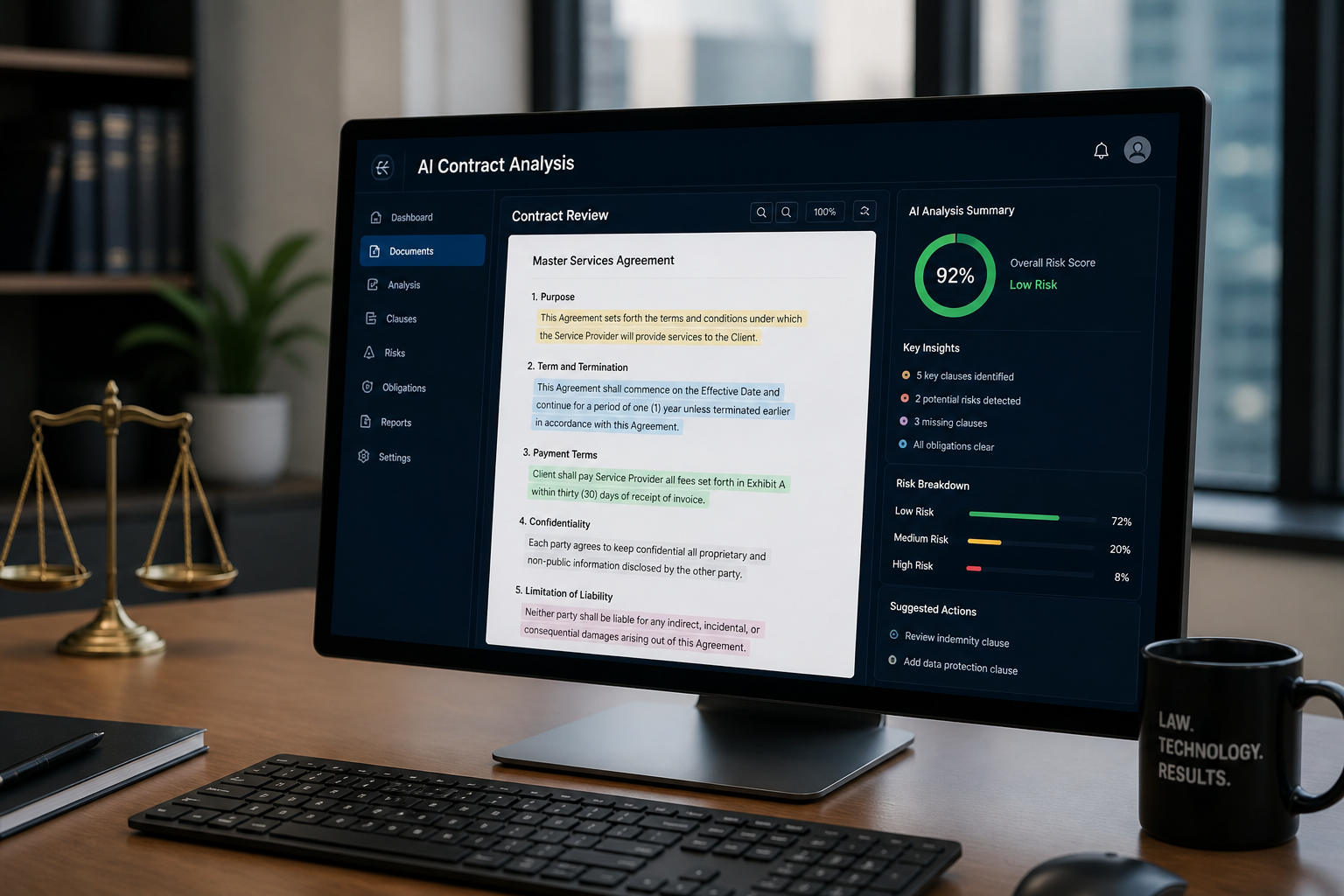
For example, an AI platform can scan a service agreement and identify payment terms, termination clauses, indemnity language, confidentiality duties, renewal terms, and liability limits. Instead of starting with a blank review, legal professionals can begin with a structured summary of the document.
This does not mean AI replaces lawyers. Contract language often depends on business goals, negotiation history, jurisdiction, and risk tolerance. AI can help organize the information, but human review remains necessary. Legal professionals still need to interpret meaning, apply judgment, and decide what matters most in each situation.
Why Contract Review Takes So Much Time
Contracts are often long, repetitive, and full of detailed language. A single agreement can include dozens of clauses that affect payment, privacy, liability, deadlines, dispute resolution, and termination rights. Reviewing each section manually can take hours, especially when the document is complex or poorly organized.
Many legal teams also review large volumes of similar documents. Businesses may need to examine vendor agreements, employment contracts, leases, nondisclosure agreements, licensing terms, and partnership agreements. When hundreds of documents require review, manual work can slow down legal operations.
AI tools help by scanning documents quickly and pulling out key information. A lawyer can then focus on the clauses that need closer attention. This creates a more efficient process while keeping legal judgment at the center of the work.
How AI Helps Identify Key Clauses
One of the most useful features of AI in contract review is clause detection. AI tools can recognize common contract sections and label them for easier review. These sections may include confidentiality, governing law, indemnification, limitation of liability, payment obligations, insurance requirements, intellectual property ownership, and dispute resolution.
This helps legal professionals avoid missing important provisions. It also allows teams to compare similar clauses across multiple contracts. For example, a company may want to know which vendor agreements include automatic renewal terms. AI software can scan a group of contracts and identify those clauses faster than manual review.
Legal professionals can also use AI to check whether a contract includes required language. If a company uses standard clauses for data privacy, payment timing, or termination rights, AI can help flag documents that do not match those standards.
AI and Risk Detection in Legal Documents
AI tools can help identify potential risks hidden in contract language. Some platforms assign risk scores to clauses or highlight language that differs from a company’s preferred terms. This allows legal teams to prioritize documents that need immediate attention.
For example, an AI tool might flag a contract with unlimited liability, missing confidentiality terms, vague payment language, or one-sided termination rights. These alerts can help legal professionals focus their review on areas that may affect the client or organization.
Risk detection is especially useful for companies that handle many contracts at once. Instead of reviewing every document with the same level of detail, legal teams can sort contracts by risk level. Higher-risk contracts can receive deeper legal review, while lower-risk agreements may move through the process more quickly.
How AI Improves Legal Document Analysis
Legal document analysis goes beyond contract review. AI can also assist with due diligence, litigation document review, compliance audits, and internal investigations. In each of these tasks, legal professionals often need to review large amounts of written material and find relevant details.
AI can search documents for names, dates, obligations, legal issues, and repeated patterns. It can also summarize long documents into shorter overviews. This helps lawyers understand the main points before performing a deeper review.
For legal teams handling mergers, acquisitions, or corporate audits, AI can help organize massive document sets. It can identify contracts with change-of-control provisions, unusual renewal terms, or missing signatures. This can reduce review time and help teams prepare more complete reports.
The Role of Natural Language Processing
Natural language processing, often called NLP, allows AI systems to interpret human language. In contract review, NLP helps software understand legal phrases, sentence structure, clause relationships, and document context.
This matters because legal language is not always simple. A contract may use complex wording, references to other sections, or phrases with specific legal meaning. NLP helps AI tools recognize these patterns and classify contract language more accurately.
For readers who want a broader overview of artificial intelligence concepts, IBM’s guide to artificial intelligence provides a helpful introduction. For a deeper look at legal technology and professional responsibility, the American Bar Association Law Technology Today resource also covers technology topics that affect legal practice.
Why Human Judgment Still Matters
 AI can identify clauses and summarize language, but it cannot fully understand business priorities or legal strategy. A clause that looks risky in one contract may be acceptable in another. Context matters.
For example, a limitation of liability clause may be standard in one industry but unacceptable in another. A termination provision may seem strict, but it may reflect the bargaining position of the parties. AI can flag the issue, but a lawyer or legal professional must decide what it means.
This is why AI works best as a support tool. It can reduce repetitive work, surface important details, and organize documents. Human reviewers still provide legal interpretation, negotiation strategy, and final decision-making.
AI and Contract Consistency
Consistency is another major benefit of AI contract review. When different people review documents manually, they may describe risks in different ways. AI can help standardize the review process by applying the same rules to each document.
For businesses, this can improve internal workflows. Legal teams can create playbooks that define preferred contract language and unacceptable terms. AI tools can then compare contracts against those standards.
This approach helps legal departments maintain a more organized contract review process. It also supports better reporting because teams can track common contract issues across departments, vendors, or clients.
How AI Supports Faster Negotiations
Contract negotiations often slow down when parties need time to identify issues and draft revisions. AI can help speed up this process by highlighting problematic clauses early.
Some tools can suggest alternative language based on approved templates or internal playbooks. A legal professional can review the suggestion, revise it, and decide whether it fits the negotiation.
This can make negotiations more efficient. Instead of spending time searching for every issue, legal teams can focus on the most important terms. Faster review can also help businesses move deals forward without ignoring legal risk.
Common Uses of AI in Contract Review
AI contract review tools are used in many legal and business settings. Law firms may use them to support client work, especially when reviewing large document sets. Corporate legal departments may use them to manage vendor agreements, employment contracts, and compliance documents.
Procurement teams may use AI to check supplier contracts for payment terms, delivery obligations, and risk allocation. Human resources teams may use it to analyze employment agreements, offer letters, and policy documents. Compliance teams may use AI to find privacy terms, data security provisions, or regulatory obligations.
AI can also support contract lifecycle management. This includes drafting, reviewing, approving, storing, renewing, and tracking contracts. When AI is connected to a contract management system, teams can monitor deadlines, renewal dates, and obligations more easily.
Potential Challenges of AI Contract Review
Although AI offers many benefits, it also has limitations. Legal documents can be highly specific, and AI tools may not always understand unusual wording or industry-specific terms. A tool may flag language as risky even when it is acceptable, or it may miss a subtle issue that requires legal judgment.
Data quality is another concern. AI tools need strong training data to perform well. If the system was trained on limited or outdated documents, its results may be less reliable. Legal professionals should review AI output carefully and avoid relying on automated results alone.
Privacy and confidentiality also matter. Contracts often contain sensitive business information. Legal teams should understand how an AI provider stores, processes, and protects uploaded documents. The Federal Trade Commission’s privacy and security guidance offers useful information for businesses thinking about data protection.
Ethical Considerations for Legal Professionals
Legal professionals using AI should consider accuracy, confidentiality, supervision, and accountability. AI tools can help with review, but lawyers remain responsible for the final work product.
Before using AI, legal teams should understand the tool’s limitations. They should know whether the system stores user data, whether documents are used for model training, and whether outputs can be verified. Clear internal policies can help reduce risk.
Professional responsibility rules may also apply. Lawyers should use technology carefully and maintain appropriate supervision over work performed with AI assistance. For more guidance on technology and legal ethics, readers can review resources from the ABA Center for Professional Responsibility.
How AI May Shape the Future of Contract Review
AI in contract review is likely to become more advanced as tools improve. Future systems may provide more accurate clause comparison, better risk scoring, stronger multilingual review, and deeper integration with legal workflows.
Legal teams may also use AI to connect contract data with business operations. For example, AI could help track vendor obligations, renewal dates, insurance requirements, or compliance deadlines. This turns contracts from static documents into active sources of business information.
As adoption grows, legal professionals who understand AI tools may be better prepared to manage modern legal workflows. The strongest approach is not to replace human review, but to combine AI efficiency with careful legal judgment.
Conclusion
AI is transforming contract review and legal document analysis by helping legal professionals work faster, organize information, and identify risks more efficiently. These tools can detect clauses, summarize obligations, compare contract language, and support large-scale document review.
Still, AI should not replace human judgment. Contracts involve legal meaning, business context, and negotiation strategy. AI can support the process, but lawyers and legal professionals must guide the final analysis.
For more related insights, you can explore AI court translation and the human judgment courts still need. As legal technology continues to develop, AI contract review can become a practical tool for improving speed, consistency, and document analysis across the legal field.